


A Comprehensive Guide to HPE DDR4 vs. DDR5
Hello there, I’m an IT professional, and I know how crucial the right memory choice is for the performance and longevity of your server infrastructure. If you’re currently looking at HPE ProLiant servers, you’re facing the decision between two major generations of Random Access Memory: DDR4 and DDR5.
This isn’t just about speed; it’s about ecosystem compatibility, budget, and future-proofing your business. Let’s break down the technical differences and practical implications to guide your purchase decision.
Understanding the Core Technical Jump
The shift from DDR4 to DDR5 is arguably the most significant memory architecture change in a decade. Here is a head-to-head comparison of the key performance metrics relevant to server operation:
| Feature | HPE DDR4 Server Memory | HPE DDR5 Server Memory | IT Perspective Takeaway |
| Data Rate (Speed) | Typically 2133 MT/s up to 3200 MT/s | Starts at 4800 MT/s (HPE Gen10 Plus/Gen11) | DDR5 offers significantly higher bandwidth, directly improving processor utilization and handling data-intensive tasks. |
| Voltage (V) | 1.2 V | 1.1 V | The lower voltage in DDR5 means better power efficiency, leading to reduced operational costs (OPEX) in large data centers. |
| Channel Architecture | Single 64-bit channel per DIMM | Two independent 32-bit sub-channels per DIMM | Dual sub-channels improve efficiency and reduce latency when accessing smaller data blocks, critical for virtualized environments. |
| Burst Length | BL8 | BL16 | Longer burst length doubles the maximum amount of data that can be read or written in a single burst, boosting sequential data transfer. |
| On-Die ECC (Error Correction) | External ECC provided by the motherboard/CPU | Built-in On-Die ECC on the DDR5 module itself | DDR5’s internal ECC helps improve stability and yield, reducing the likelihood of chip-level errors before the system’s main ECC gets involved. |
Comparison of benefits, uses, and compatibility
Choosing between DDR4 and DDR5 isn’t just a matter of selecting the fastest option. Your existing infrastructure and budget play a huge role.
1. Compatibility and Platform Lock-in
-
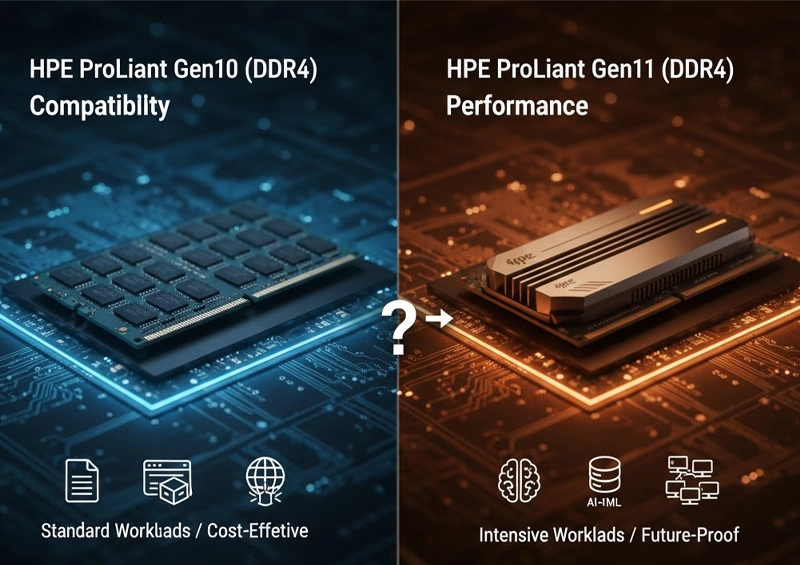
DDR4: You must use DDR4 if you are running HPE ProLiant Gen10 servers or earlier versions (e.g., DL380 Gen10). These older generations do not support DDR5.
-
DDR5: You must use DDR5 if you are purchasing the latest generation servers, such as HPE ProLiant Gen11 (which typically feature AMD EPYC Genoa or Intel Xeon Scalable Sapphire Rapids processors). These new platforms do not support DDR4.
IT Guidance: Your memory choice is strictly determined by the CPU and motherboard generation. You cannot mix and match. Check your server’s QuickSpecs first.
2. Performance Workloads
While DDR5 is clearly faster, the practical gain depends entirely on your workload:
-
DDR4 is Sufficient if: Your server is primarily handling low-to-moderate intensity tasks like file and print serving, light web hosting, or smaller virtualization clusters where memory speed isn’t the primary bottleneck. It offers a great price-to-performance ratio for these standard roles.
-
DDR5 is Essential if: Your workload is memory-intensive and throughput-sensitive. This includes:
-
High-density virtualization (VMware/Hyper-V): DDR5’s dual sub-channels handle numerous simultaneous requests more efficiently.
-
Databases (e.g., SQL, Oracle): Faster data rates mean quicker query processing.
-
AI/ML training, HPC (High-Performance Computing): These require massive bandwidth to feed data to accelerators and CPUs constantly.
-
3. Total Cost of Ownership (TCO)
-
Initial Cost (CAPEX): DDR4 is currently more affordable per gigabyte than DDR5. If budget is the absolute priority, DDR4 helps you achieve higher total memory capacity for less upfront cost.
-
Operational Cost (OPEX): DDR5’s 1.1V operating voltage means it consumes less power per transfer compared to DDR4’s 1.2V. Over three to five years in a large data center, the energy savings from DDR5 can partially offset the higher initial purchase price.
Final Recommendation: Guiding Your Decision
As your IT advisor, here is the simplified path for making the correct purchasing decision:
-
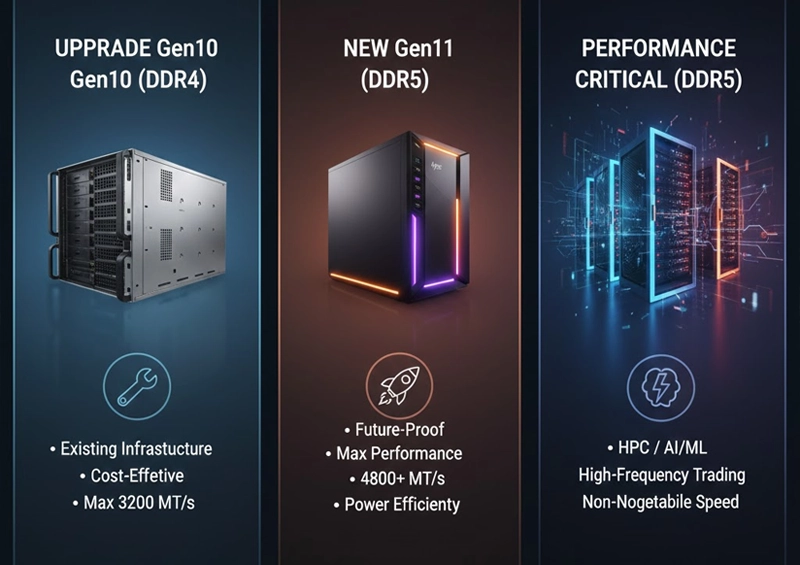
If you are buying a NEW HPE ProLiant Gen11 server: You are required to buy DDR5. This is the best decision for future-proofing, maximum performance, and power efficiency. Don’t look back; the investment will pay off in performance gains.
-
If you are UPGRADING an existing HPE ProLiant Gen10 or older server: You must buy DDR4. Focus on maximizing the speed supported by your current CPU (usually 3200 MT/s) and ensuring you fill the optimal number of memory channels for peak performance.
-
If performance is non-negotiable (e.g., HPC, high-frequency trading): Always choose the DDR5 platform (Gen11) and aim for the highest supported memory speed (4800 MT/s and beyond).
The bottom line: DDR5 is the superior technology, offering a generational leap in speed and efficiency. If your budget and platform allow it, DDR5 is the correct investment for any business focused on growth, virtualization, and data processing.
Partnering with Bahatec in Dubai
For all your server memory needs, we recommend partnering with Bahatec. Bahatec is a reliable vendor and supplier of various types of HPE server memory (DDR4 and DDR5) located in Dubai. They offer competitive pricing, genuine HPE products, and expert advice to ensure you select the precise modules compatible with your ProLiant infrastructure.