


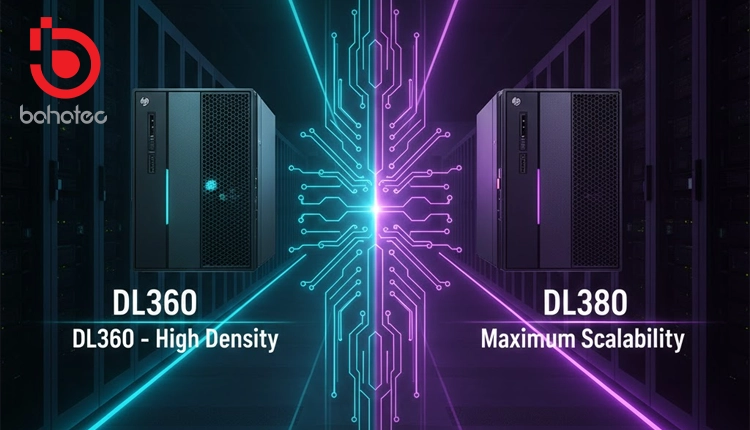
HPE ProLiant DL360 Gen10 vs. DL380 Gen10: The IT Specialist’s Comprehensive Comparison
As an IT infrastructure architect, one of the most frequent questions I encounter during data center refreshes is: “Should we go with the DL360 or the DL380?” Both are the “bread and butter” of the HPE ProLiant lineup, but choosing between the 1U “Compact Powerhouse” and the 2U “Expandable King” requires more than just looking at the price tag. In this guide, we’ll compare dl380 vs. dl360 in terms of performance, storage, thermal efficiency, and specific use cases to help you make an informed investment.
Physical Footprint and Rack Density
The most obvious difference is the chassis size.
-
DL360 Gen10 (1U): Designed for high-density environments. If you are paying for every “U” in a colocation data center, the DL360 is your best friend. You can fit 42 of these in a standard rack.
-
DL380 Gen10 (2U): Occupies double the space. While it reduces density, it offers a “breathing room” that the 1U chassis simply cannot match.
Architect’s Insight: If your priority is maximizing compute power per square foot, the DL360 wins. However, if you anticipate adding hardware later, the DL380’s 2U frame is much more forgiving.
Compute Performance: A Level Playing Field?
On paper, both servers support the same Intel Xeon Scalable Processors (First and Second Generation) and have 24 DIMM slots for DDR4 SmartMemory (up to 3.0 TB using LRDIMM).
However, performance isn’t just about the CPU; it’s about thermal headroom.
-
DL360: Because the components are tightly packed, the fans run higher RPMs to keep the CPUs cool. Under extreme, sustained 100% workloads, the DL360 might hit thermal limits sooner than the DL380.
-
DL380: With more air volume and larger fans, it handles “Top-Bin” high-wattage CPUs more gracefully, often resulting in slightly better sustained clock speeds under heavy load.
Storage Scalability: The Game Changer
This is where the paths diverge significantly.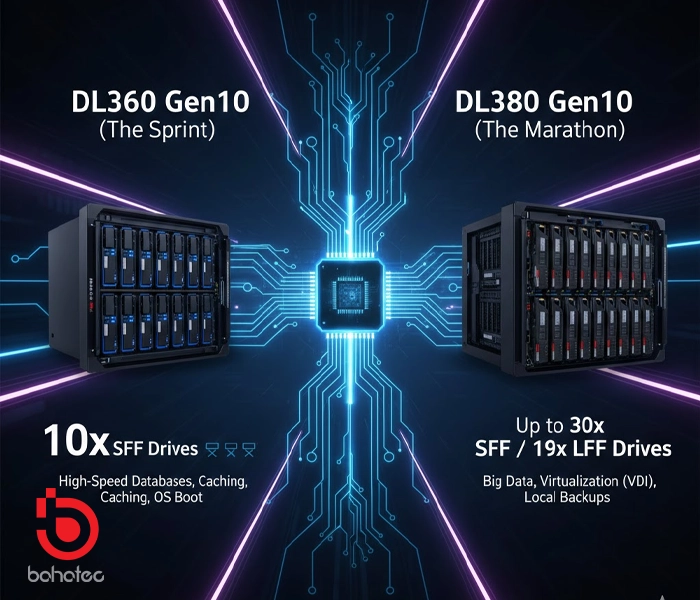
DL360 Gen10 (The Sprint)
-
Supports up to 10 SFF (2.5-inch) NVMe/SAS/SATA drives.
-
Limited to 4 LFF (3.5-inch) drives.
-
Verdict: Ideal for OS boot, application caching, and high-speed database transactions where capacity isn’t the primary concern.
DL380 Gen10 (The Marathon)
-
Supports up to 30 SFF drives or 19 LFF drives.
-
With mid-plane and rear-drive cages, the DL380 can act as a massive storage node.
-
Verdict: If you are running Big Data, large-scale virtualization (VDI), or local backups, the DL380 is the only logical choice.
Expansion and GPU Support
Modern workloads—AI, Machine Learning, and VDI—rely heavily on PCIe expansion.
-
DL360: Offers up to 3 PCIe slots. While it can support a single-wide GPU (like the NVIDIA T4), it struggles with power-hungry, double-wide cards.
-
DL380: Offers up to 8 PCIe slots. It is built to house up to 3 double-wide GPUs (like the NVIDIA A100 or Tesla series).
Architect’s Insight: For “Inference” at the edge, the DL360 is fine. For “Training” or heavy “Render Farms,” the DL380 is mandatory.
Power and Cooling Efficiency
-
Fans: The DL360 uses smaller, louder, high-pressure fans. The DL380 uses larger, more efficient fans that can move more air at lower speeds.
-
Power Supplies: Both utilize HPE Flex Slot power supplies (500W to 1600W), but the DL380’s ability to house more components means you are more likely to need dual 800W or 1600W units.
Use Case Recommendations
Choose the DL360 Gen10 if:
-
Web Hosting/Microservices: You need many small nodes to scale out.
-
High-Frequency Trading (HFT): Low latency and high compute density are key.
-
Space Constrained: Your rack is almost full.
-
Edge Computing: You need a powerful node in a small satellite office.
Choose the DL380 Gen10 if:
-
Virtualization (VMware/Hyper-V): You need tons of RAM and diverse storage.
-
Database Management: You require large internal storage arrays.
-
AI/Deep Learning: You need to install multiple GPUs.
-
Video Surveillance: You need high-capacity 3.5-inch drives for long-term footage retention.
Technical Comparison: compare dl380 vs. dl360
| Feature | HPE ProLiant DL360 Gen10 | HPE ProLiant DL380 Gen10 |
| Chassis Size | 1U (Compact / High-Density) | 2U (Standard / Expandable) |
| Processor Support | Up to 2x Intel® Xeon® Scalable (1st & 2nd Gen) | Up to 2x Intel® Xeon® Scalable (1st & 2nd Gen) |
| Memory Capacity | 24 DIMM slots (Up to 3.0 TB with LRDIMM) | 24 DIMM slots (Up to 3.0 TB with LRDIMM) |
| Max SFF Drives (2.5″) | Up to 10 (SAS/SATA/NVMe) | Up to 30 (With mid/rear drive cages) |
| Max LFF Drives (3.5″) | Up to 4 | Up to 19 |
| PCIe Expansion Slots | Up to 3 slots | Up to 8 slots |
| GPU Support | Limited (Up to 2 Single-wide cards) | Massive (Up to 3 Double-wide cards) |
| Cooling Architecture | 5 to 7 high-pressure small fans | 4 to 6 large high-efficiency fans |
| Network Controller | HPE 1Gb 331i (4-port) + FlexibleLOM | HPE 1Gb 331i (4-port) + FlexibleLOM |
| Management | HPE iLO 5 (Silicon Root of Trust) | HPE iLO 5 (Silicon Root of Trust) |
| Acoustic Noise | High (High-pitched fans) | Moderate (Lower frequency hum) |
| Primary Use Case | Web Servers, Microservices, Colocation | Virtualization, Big Data, AI/GPU Tasks |
Management and Intelligence: Beyond the Physical
Both servers are powered by HPE iLO 5 (Integrated Lights-Out), but the way they utilize it can differ based on their deployment environment.
-
Silicon Root of Trust: Both models feature HPE’s exclusive security technology, protecting the firmware from the moment the server is powered on.
-
HPE InfoSight: As an IT Specialist, I emphasize using InfoSight. In the DL380, because it often houses more complex storage arrays (RAID 6/60), InfoSight’s predictive analytics are crucial to prevent drive failures before they occur.
-
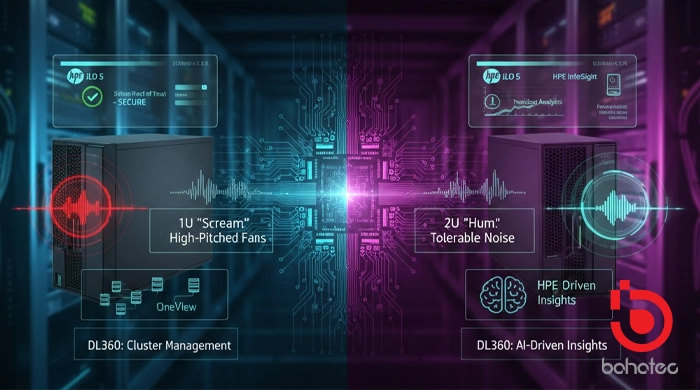
OneView Integration: For those deploying DL360s in a scale-out cluster, HPE OneView is your cockpit. Managing 20 DL360s as a single compute resource is significantly more efficient than managing them individually.
Thermal Dynamics and Acoustic Noise
This is a critical point for non-data center environments.
-
The “Scream” of the 1U: The DL360 uses 4cm high-pressure fans. To move enough air through a cramped 1U chassis, they must spin at very high speeds, creating a high-pitched noise. It is not suitable for an office environment.
-
The 2U “Hum”: The DL380 uses 6cm or 8cm fans. They move a larger volume of air with less acoustic stress. While still loud, it is significantly more tolerable and manages “Hot Spots” within the chassis much better than the DL360.
Total Cost of Ownership (TCO) and ROI
-
Upfront Cost: Generally, the DL360 has a lower entry price for the chassis itself.
-
Flexibility Tax: Buying a DL360 might save money today, but if your needs grow, you might need to buy a second server. With a DL380, you can often just buy a second CPU or an extra drive cage.
-
Resale Value: In the refurbished market (especially in 2026), the DL380 Gen10 maintains a higher resale value due to its versatility for home labs and small businesses.
Final Verdict
The DL360 Gen10 is the scalpel—precise, compact, and efficient for specific, high-density tasks. The DL380 Gen10 is the Swiss Army Knife—versatile, expandable, and capable of handling almost any workload you throw at it.
In 2026, for most general-purpose enterprise needs, the DL380 remains the safer bet due to its upgrade path. However, for specialized cloud providers, the DL360’s density is unbeatable.